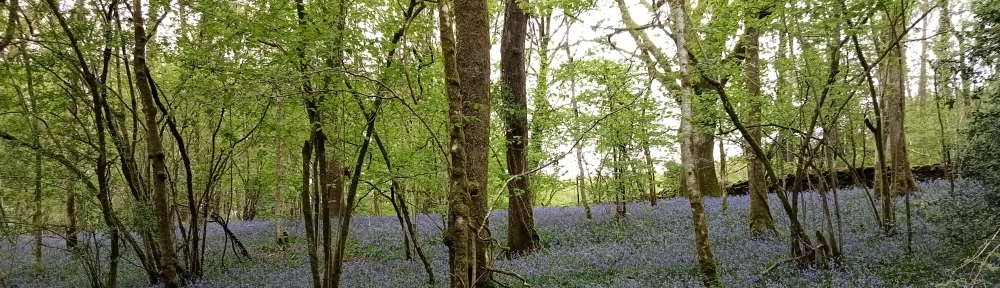
How has the environment changed in this area over the eons?
Tropical Kendal: 300 million years ago
Three hundred million years ago the land on which Kendal now stand was located just south of the equator and was covered by dense tropical forests and swamps dominated by giant fern-like plants and their close relatives.Plate tectonics was causing the continents to drift apart, at a rate of only a few centimetres a year, but sufficient to cause the land on which Kendal now stands to move very slowly northwards to its present location.
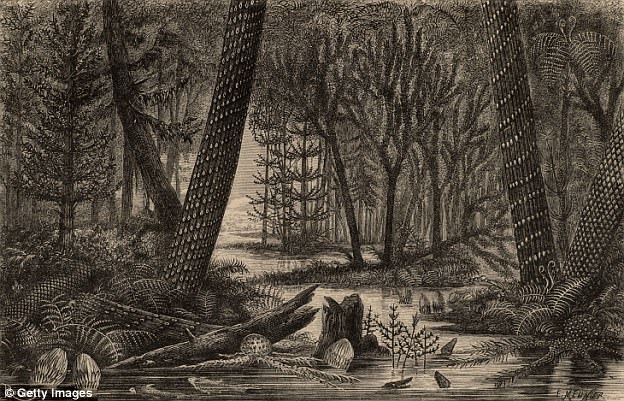
Tropical Kendal existed in what geologists call the “Carboniferous Period”. Carbon dioxide concentrations in the atmosphere were much higher than they are today and vast swamp forests began to lock up huge amounts of carbon in decomposing vegetation. Later these formed under-ground deposits of fossil fuels such as coal. The recent use of these fossil fuels, which accelerated during the industrial revolution until modern times, is mainly responsible for the increasing levels of carbon dioxide in our atmosphere and the global climate crisis we are dealing with today. At that time flowering plants had not yet evolved – but there would have been plenty of ferns. At ground level these tropical forests would been moist, dark places with little light penetrating to the ground: ideal for ferns. In this tropical world, ferns and their close relatives (clubmosses and horsetails) dominated the scene. The actual species that were around at that time no longer exist. In Victorian Times, over-zealous collecting of native ferns led to a destruction of some fern habitats in parts of the country. It’s no longer legal to dig up most native plants from the countryside but many species are still decreasing in abundance. Do you think this matters and, if so, what do you think are the main reasons for the continuing declines?
Think about the great job ferns did all that time ago in helping to create today’s climate. And perhaps you can also consider how by reducing your personal carbon footprint you can help avoid dangerous climate change in the future.
Return of the forests: 12,000 – 6,000 years ago
The last ice age ended about 12,000 years ago leaving behind Cumbria’s now familiar landscape of upland fells cut by deep valleys with lakes and rivers.
For the next 6,000 years, largely undisturbed by humans, mixed temperate forests began to dominate the landscape. It was a period known as the Mesolithic (or middle stone-age) when small groups of hunter-gatherers were constantly on the move hunting wild animals, fishing and gathering wild plants to survive. The pollen record shows that juniper (now mainly confined to the up-land fells) was an early coloniser, followed by birch, willow, hazel, elm, oak, pine, alder, lime, ash, maple and yew. Ferns and woodland flowers proliferated below the trees. Large animals of the arctic tundra, such as mammoths and aurochs (large oxen), became extinct. Animals more at home in the forests, such as deer, elk, beavers and wolves, became more abundant.
The Mesolithic period in Britain ended about 6,000 years ago. But humans were about to start making some big changes to this sylvan scene as hunter-gathering gave way to farming in the Ne-olithic Period (the New Stone Age). This made the land more productive and lead to an increasing population and a steady decline in forest cover.
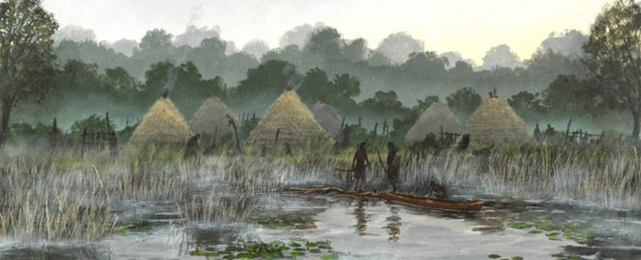
We don’t really know much about this period in Kendal’s history. Our earliest stone age artefact is a flint scraper about 7,000 years old and found near the river on the southern edge of town. But we can speculate. Here’s an artist’s impression of Star Carr, a world famous archaeological site in Yorkshire, dating to around 11,000 years ago. Would we have had something similar on the banks of the River Kent supporting a small community of hunter-gatherers and how long would they have stayed before moving on? If not, why not? And what lessons, if any, can we learn from the hunter-gatherer way of life and are they still relevant today?
As the glaciers melted, the retreating ice left behind large mounds (drumlins) made up of soils and boulders – like the one on which Kendal Castle was much later built. The landscape would have been dominated by shady forests through most of this period. The forest floor would have been covered with native woodland flowers such as wild daffodils, bluebells, and snowdrops, and meadow fritillaries and woodland herbs such as hedge woundwort and primroses could have colonised woodland glades created by fallen trees and the grazing of deer. There were many food plants (such as wild garlic, ground elder, fungi, fruits and nuts) that would have contributed to human diets at that time.
The Romans : from AD 95 to AD 410
The Romans built a fort on the River Kent to support their military occupation of the north. There is little evidence that they had a lasting impact on the Kendal landscape but they were a practical and orderly bunch and brought over 100 new plant species to Britain. These were mainly useful – for example, crops (such as cabbages) or medicinal herbs. But weeds like the now dreaded ground-elder also arrived.
In Kendal’s Roman Fort they left behind part of a statue of Bacchus – their God of “Fun, Festivals and Wine“. This can be seen in Kendal Museum with many other fascinating exhibits. Bacchus was also a popular subject for Roman mosaics across the empire, two of which we’ve copied here to encourage Kendal’s party mood.
From the Dark Ages (AD500) to the NHS (1948)
Our wonderful National Health Service (NHS) is just over 70 years old. So what did people do in the Dark Ages, over a thousand years ago, when they got ill? They used whatever nature provided in the plants that grew around them and a risky process called “trial and error”. In Old English “wort” meant “plant” and plants were often named after the illnesses they were used to treat. Guess what these were used for:
Sneezewort — Feverfew — Lousewort (Betony) — Woundwort — Self-heal
Motherwort — Heart’s ease — Wormfern — Hart’s tongue — Soapwort
Wild plants still provide many materials for scientists to make new medicines. One of the reasons to support diversity and encourage wild plants!
Coppice woodlands: the DIY superstores of history
For thousands of years coppice woodlands were important sources for materials and tools for local people. But what is a coppice? Why was it so useful? And is it still useful in today’s world? In Medieval times these woodlands supplied the wood needed for everyday life. They were made by cutting down trees and shrubs (such as hazel) to stumps and harvesting the regrowth every 5 to 15 years to produce a crop of wooden poles. These were used for many things such as making buildings, hurdles for fencing, barrels, baskets, besoms (brooms), rakes and firewood. Later they provided the charcoal to make gunpowder in the age of muskets, cannons and empire building.
Coppice woodlands are rarer now but still provide a beautiful habitat for wildlife. But they do have their downsides. They contain little of the deadwood (like the logs you see surrounding this area) on which about 1,000 British animal species depend. And this lack of deadwood also reduces their capacity for storing carbon and mitigating climate change – and that’s bad news for all of us.
The Legend of Richard de Gylpin and the Wild Boar: reign of King John (1199-1216)
There is a local legend that a ferocious wild boar had a den in the forests on Scout Scar, a few miles to the west of Kendal. It caused great damage and terrorised pilgrims visiting the Holy Cross at Plumgarths. After a dramatic fight, Richard De Gylpin slew the boar and was well rewarded by the Baron of Kendal. Scout Scar is now home to some of the few remaining ancient woodlands close to Kendal – but the boars disappeared long ago. There is still much debate about whether the digging activity of wild boar has a positive effect on our woodlands and whether they should be allowed to return. What do you think?
Kendal Green: A Legend in the Making 1390-1767
“Kendal Green” was a coarse cloth worn by peasants and legendary rascals such as Robin Hood’s outlaws and Shakespeare’s “misbegotten knaves”. It made the town rich and famous. Kendal had an abundance of the natural resources needed to make the cloth: wool from sheep; soap from bracken; plenty of water for washing, fulling and dyeing; fuller’s teasels for raising the nap on the cloth; dye producing plants; and plenty of enterprising people to bring it all together. We don’t know exactly how “Kendal Green” was made, or what colour it actually was. Dyers’ greenweed and weld were used to dye the cloth yellow before blue dye from woad or indigo turned it green. The story of “Kendal Green” was also linked to big changes in the Kendal landscape. There were still woodlands round Kendal until over-grazing by sheep created the rocky grass-dominated fells that surrounded the town in the 18th century.
Spindle Wood: Medieval Kendal – about 1500 A.D.
Spindle is a small tree. But it produces the hard wood needed to make the “spindles” used for spinning the woollen yarns used for making the famous “Kendal Green” cloth. By the 18th century changes to land use and woodland management meant that Kendal’s woodlands had all but gone. Even so, a “Spindle Wood” survived on the edge of Kendal until the mid-19th century. It’s gone now. Although perhaps, just like the princess who pricked her finger on a spindle made of spindle, it may only be sleeping.
The Limestone Blues ….. and Greys: 1767
To the west of town is a large area of limestone called Kendal Fell. By 1767 the ancient forests that once covered it had all gone. The Fell had been overgrazed and quarried to build the stone houses that gave Kendal its nickname of the “Old Grey Town”. It had become a wasteland: “… no more than a hill full of rocks and stones”. So the area was enclosed to improve agriculture “for the benefit of the poor”, although, ironically, many commoners then lost most of their ancient rights to use it.
Kendal Fell is now a Town Green with beautiful walks through woodlands and meadows, a great Golf Course, and magnificent panoramic views over our Town and the Lakeland Fells. It also supports a fascinating variety of animals and plants including rare butterflies and a diverse range of limestone loving plants. It’s no longer a landscape that gives us the blues – it’s a wildlife haven for all to enjoy.
Fern Mania: 1850-1900
In Victorian times Kendal was at the centre of a national craze for collecting and growing ferns. Exotic species were introduced from abroad and, together with many varieties of native ferns, these were cultivated in “fern gardens”, often in specially landscaped rockeries or stumperies.
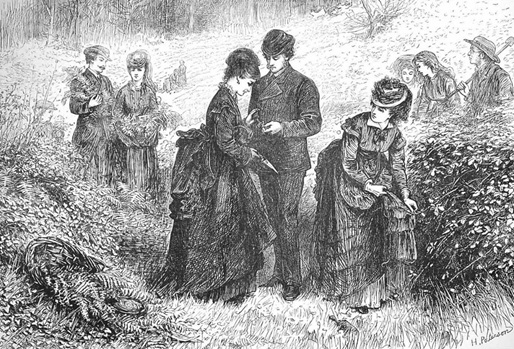
In 2018 the re-emergence of some old pieces of lead bearing obscure Latin inscriptions led to re-newed interest in Kendal’s key role in the Victorian craze (also called “Pteridomania”) for collecting ferns. The labels were probably the work of George Whitwell who looked after Kendal’s Serpentine Wood for 50 years and grew his ferns there. In 1891, George became a founder member of the British Pteridological (Fern) Society. His fern garden, next to his old cottage in Serpentine Wood on the western edge of Kendal, has recently been restored and his gravestone in the Parkside Road cemetery has also been refurbished, funded by the British Fern Society. Cumbria continues to have an active group of fern enthusiasts and national fern collections can be visited close to Kendal at Sizergh Castle and at Holehird Garden near Windermere.
In Victorian Times, over-zealous collecting of native ferns led to a destruction of some fern habitats in parts of the country. It’s no longer legal to dig up most native plants from the countryside but many species are still decreasing in abundance. Do you think this matters and, if so, what do you think are the main reasons for the continuing declines?